Your side of the partnership
Set the business priorities, approve the important calls, and keep the operation moving.
Airside manages the marketing work that turns a strong operation into qualified direct and broker demand.

Most owner-led operators do not need another vendor waiting for a task list. They need one person who understands the operation, brings the right decisions forward, and handles the work after those decisions are made.
Airside starts by fixing the foundation where needed, then manages one connected marketing program. Josh leads strategy, aviation review, communication, and core execution. Trusted specialists add capacity when the work calls for it, while you keep one point of contact and one accountable partner.
The monthly priority may be a fleet-page rebuild, a city search campaign, broker material for a new aircraft, an empty-leg audience, or a better inquiry workflow. The scope stays connected to the operation instead of forcing the same deliverable count every month.
Set the business priorities, approve the important calls, and keep the operation moving.
Turn those priorities into campaigns, content, systems, reporting, and the next recommended decision.
Keep aircraft photography, fleet stories, brand voice, sales materials, and new-aircraft campaigns aligned with the quality already inside the operation. Major identity or website work can be built as a foundation, then managed as the fleet and markets change.
Build useful fleet, market, and buyer-question pages that can be found, understood, and cited across traditional and AI-assisted search. Review real query and inquiry data to improve pages instead of publishing generic content on a fixed schedule.
Coordinate useful operator updates, empty-leg alerts, social content, broker materials, and outreach without making the owner manage each channel. Airside handles the system and content while the operator's authorized team keeps control of availability, quotes, and sales conversations.
Traffic matters only when the operator can see what happened next. Airside connects campaign source, trip context, inquiry type, qualification, quote activity, and booking outcome so monthly decisions are based on demand rather than impressions alone. The existing CRM remains the first choice when it can hold that workflow. Custom tooling is reserved for gaps that aviation fields, broker lanes, or empty-leg matching make impossible to handle cleanly.
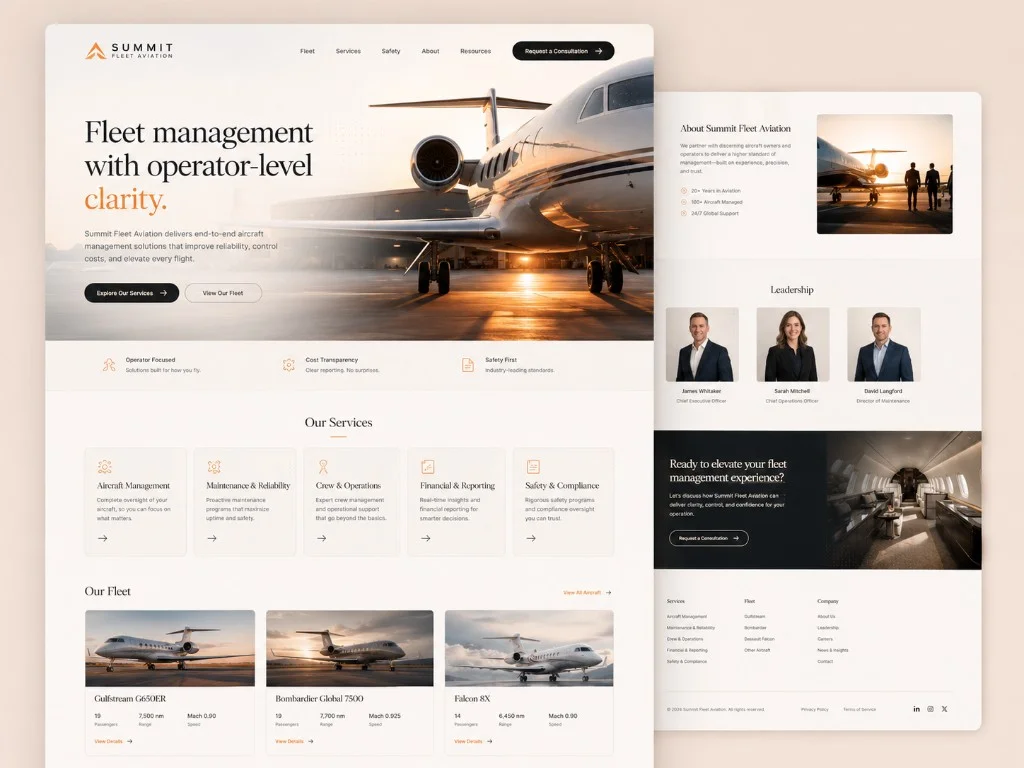
The operator had almost no search visibility and struggled to put unsold empty-leg inventory in front of useful audiences. Airside connected targeted city content, fleet and website work, social and email coordination, automated empty-leg notifications, AEO development, and backend inquiry visibility.
The work is ongoing. Early direct inquiries improved, and the client reported roughly 30% booking lift on select mid-size and super-mid aircraft after launch. Website, imagery, routing, sales follow-up, market conditions, and timing changed together, so the result is treated as multi-factor rather than crediting one tactic.
Client identity and operating details remain private.Review the fleet, markets, current channels, buyer paths, broker relationships, sales ownership, and internal inquiry workflow.
Scope the website, brand, content, photography, tracking, or systems work needed before ongoing growth, then give it a clear approval path.
Run the agreed search, content, email, social, website, broker, and campaign priorities as one program instead of separate vendor tasks.
Report qualified demand, explain what changed, surface the decisions that matter, and execute the next approved priorities.
The partnership is built to reduce daily owner involvement while keeping important decisions visible.
Scope can include SEO and AEO, website and fleet-page management, content, email, social, new-aircraft and market campaigns, broker-facing marketing systems, reporting, and optional paid media. Priorities are set around the operation instead of fixed public deliverable quotas.